

Energy renovation in Meurthe-et-Moselle (54)
Meurthe-et-Moselle has a housing stock shaped by its urban and industrial history. Nancy and its conurbation are lined with faubourg apartment blocks and workers’ houses, often dating from before 1948. Further north, the Longwy basin still has its former steelworks estates, built in series and poorly insulated from the outset. Part of the stock remains connected to a communal heating system, which changes the nature of the works that are possible. Winters are cold and the heating season long. GRAM Énergie reads the building before proposing a suitable renovation plan.

Tip: have your energy performance certificate (DPE) and energy bills to hand for a more accurate estimate.
Meurthe-et-Moselle buildings and their energy challenges
The faubourg blocks and town houses of the Nancy conurbation largely date from before 1948. Stone or brick walls, timber floors, windows replaced over time without any treatment of the reveals: the envelope accumulates local weaknesses. These terraced homes, tall and narrow, lose heat mainly through the roof and the exposed façades. Planning rules there often limit work on visible façades, which points towards internal solutions.
The former workers’ estates of the Longwy basin follow a different logic. Built in series to house steelworks staff, they have repetitive layouts and an envelope designed with no thermal requirement. Lofts, gable walls and windows account for the heat losses there. The advantage lies in the uniformity of the stock: a well-run survey applies to many comparable homes and the phasing of the works can be planned clearly.
Part of the Meurthe-et-Moselle stock is still served by communal heating. In that case, replacing the heat source is not a matter for the individual owner alone, and the scope for individual action lies first in the envelope, the windows and the controls. The cold climate and the length of the heating season make those items all the more worthwhile. We set out that framework at the first visit, before making any proposal.
Our services in the 54
Global energy renovation
In an older home, treating a single item gives little in return. Global energy renovation organises the works in order: envelope, ventilation, then the heat source. In Meurthe-et-Moselle, this approach suits faubourg houses as well as homes in the former estates. We build a staged plan suited to the budget and to the way the home is occupied.
See the page: Global energy renovation in Meurthe-et-Moselle (54)

Heat pump
A heat pump is a worthwhile replacement for an old individual boiler, provided the home is already insulated. Lorraine winters call for a precise study of the sizing and the flow temperature. In dense terraced housing, the siting of the outdoor unit needs particular attention: boundary distances, access and the acoustic comfort of the neighbours.
Insulation
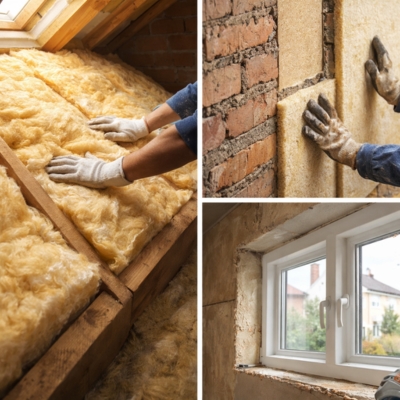
Loft insulation remains the first item, followed by the gable walls and the windows. On the pre-1948 houses of the Nancy conurbation, protected façades point towards internal insulation with materials compatible with old walls. On the estates of the Longwy basin, external solutions become feasible again depending on local rules.
Thermodynamic water heater
Where the heating is communal, domestic hot water often remains individual and weighs on the bill. A thermodynamic water heater takes over from an old electric cylinder. It requires a ventilated room of sufficient volume, which we check on site before including it in the project.
See the page: Thermodynamic water heater in Meurthe-et-Moselle (54)

Energy audit
An energy audit establishes the real condition of the home: heat losses, thermal bridges, ventilation, heating system and the room for manoeuvre allowed by the type of heating. It offers costed scenarios in a clear order. On the older buildings of Meurthe-et-Moselle, whose wall build-ups are rarely documented, this stage secures the decisions.

Ventilation (VMC)
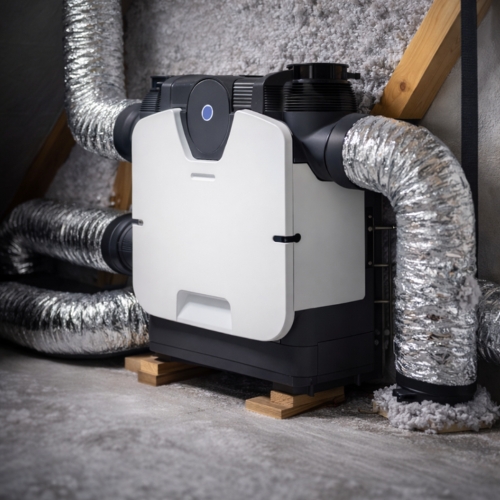
Older homes ventilated through their own leaks and their chimney flues. As soon as the envelope is reworked, moisture builds up. We install suitable systems: humidity-controlled single-flow VMC (French mechanical ventilation), or a heat-recovery double-flow unit when the airtightness justifies it. This item protects indoor air quality and the durability of the walls that have been treated.
Smart thermostat
When the heat source cannot be changed, the controls become the main lever. A smart thermostat adjusts temperatures according to the rooms and the hours of occupation, and avoids heating an empty home. Fitting is light and involves no major works. We set the time schedules together at commissioning.
The towns where we work in the 54
- Nancy: faubourg blocks and town houses from before 1948, where protected façades often point towards internal insulation.
- Vandœuvre-lès-Nancy: a dense commune of the conurbation, with a large stock of flats, where controls and windows offer the first levers.
- Lunéville: a town with an old centre and suburban districts, where lofts have frequently been left without proper insulation.
- Toul: an old town of terraced town houses, whose roofs and gable walls account for most of the heat losses.
- Villers-lès-Nancy: a residential commune in the Nancy ring, with varied detached houses and often ageing equipment.
- Longwy: a former steelmaking basin, with uniform workers’ estates whose envelope was never designed to hold heat.
- Laxou: a commune mixing flats and detached houses, where the phasing of the works is decided according to the type of heating.
- Pont-à-Mousson: a town of old stone buildings and workers’ districts, whose large houses call for a serious preliminary survey.
- Jarville-la-Malgrange: a commune in the inner conurbation, with an older residential stock, where loft insulation remains the first useful item.
- Saint-Max: a dense residential area close to Nancy, with old terraced houses whose windows deserve careful examination.
Grants and financing for your works
Several national schemes can support a project carried out in Meurthe-et-Moselle: MaPrimeRénov’ (the French State renovation grant), the certificats d’économies d’énergie (CEE) (energy saving certificates funded by energy suppliers), the reduced rate of TVA (French VAT) on energy renovation works and the éco-prêt à taux zéro (the interest-free renovation loan, also called éco-PTZ). Access depends on the nature of the works, the characteristics of the home and the household’s circumstances, and requires the use of a company holding RGE certification (Reconnu Garant de l’Environnement, the French quality label for energy renovation firms). The rules change regularly: we review your eligibility during the personalised study. The public service France Rénov’ lists the schemes in force and their conditions.
The order in which applications are submitted is prepared before the quotation is signed.
How a project runs with GRAM Énergie

A first conversation about your enquiry
The home, the type of heating, the works you have in mind and the constraints of the building.

Step 2
An on-site technical visit, with measurements, identification of the walls, inspection of the existing installation and of access.

Step 3
A detailed costed proposal, setting out the chosen scenario of works and the grants that can be claimed.
Carrying out the works
Schedule communicated in advance, coordination of the trades involved, protection of the property.

Step 5
Commissioning, an explanation of how to control the equipment and handover of the follow-up documents.
Frequently asked questions
What can be done in a home with communal heating?
A great deal, but not everything. The heat source is not a matter for the individual owner alone. On the other hand, insulating accessible lofts, replacing windows, treating the walls facing outside and improving the controls remain effective individual levers. We set out that scope at the visit, before any costed proposal.
Can a faubourg house in Nancy be insulated externally?
Often not on the visible façades. Planning rules and the opinion of the heritage authorities govern the appearance of the old streets. We check this point beforehand. Internal insulation, combined with work on the loft and the windows, then brings a serious gain without changing the appearance of the building.
Are the former workers’ estates easy to renovate?
Their uniformity is an asset. The layouts repeat, and so do the problems: poorly insulated lofts, exposed gable walls, original windows. A well-run survey on one home therefore sheds light on the next. The phasing of the works can be planned clearly, which simplifies both the organisation of the project and the grant applications.
Does a heat pump hold up through Lorraine winters?
Yes, if the sizing is correct. Current models operate at low outdoor temperatures, but efficiency depends on the insulation and on the flow temperature of the emitters. We deal with the envelope first, check the existing radiators, then provide back-up heating when the coldest spells justify it.
Do you work beyond the Nancy conurbation?
Yes. Our coverage area takes in the whole of Meurthe-et-Moselle, from the Longwy basin to the Lunévillois, by way of the Toulois and the Val de Lorraine. The list of communes above is not exhaustive. Tell us yours in your enquiry: we will confirm that we can work there.
Let’s talk about your project
Are you planning energy renovation works in Meurthe-et-Moselle? Describe your home, your type of heating and your constraints through our contact form. We then arrange a personalised study and propose a scenario suited to your building and your budget. You can also visit our energy renovation in Grand Est page to discover the other departments covered.