


Heat pump in Ardennes (08)
Installing a heat pump in Ardennes (08) requires looking beyond simply replacing a boiler. In a department where the heating season is long, the thermal behaviour of the home, its insulation level and the existing emitters directly influence the choice of system. A stone house with poorly protected loft space does not have the same requirements as an already renovated detached house. Before selecting the equipment, heat loss, the temperatures required for heating and the building’s technical constraints must therefore be assessed so that the installation is sized for a coherent situation.

Tip: have your energy performance certificate (DPE) and energy bills to hand for a more accurate estimate.
Why install a heat pump in Ardennes
The climate in Ardennes requires heating to operate for a significant part of the year. In this context, a heat pump must be selected according to the home’s actual requirements during colder periods, not simply according to its floor area. Older houses with thick stone walls may retain strong thermal inertia while still losing substantial heat through the roof, walls or floors. When these weaknesses remain, the required output stays high and must be assessed before any decision is made.
Replacing an old oil boiler can be considered in many homes, particularly where connection to gas is unavailable. However, it is still preferable to check possible improvements to the building envelope first. Upgrading loft insulation or treating walls more effectively changes heat loss and may lead to different sizing. In Ardennes, this coordination helps avoid selecting oversized equipment to compensate for weaknesses that will later be corrected.
What heat pump installation includes
Assessment of heating requirements
A heat pump project begins with an assessment of the home, the heated volumes, its building envelope and the equipment currently in place. Output cannot be determined solely from the number of square metres. The condition of the loft, walls, openings and floors influences requirements. The aim is to establish a technical basis before choosing the type and characteristics of the appliance.
Checking the existing emitters
Water-filled radiators, underfloor heating and other emitters do not all operate at the same temperatures. Their compatibility must be assessed because an existing installation designed for an older boiler may require water temperatures different from those intended with the new system. The size of the radiators, their positioning and the characteristics of the hydraulic network are therefore among the elements to examine.

Choosing the location of the units
The outdoor unit requires a position compatible with the layout of the property, circulation around the home and the manufacturer’s technical requirements. Distances from the indoor unit, routes for connections and access for maintenance must also be taken into account. The location should not be decided solely according to available space: it must remain consistent with the installation as a whole.

Adapting the heating network
When the heat pump supplies a water-based circuit, the existing network must be checked. Circulation pumps, pipe diameters, balancing and the general condition of the distribution system can affect operation. Depending on the configuration, some components can be retained while others may need to be adapted. This stage ensures that the new equipment is correctly connected to the emitters rather than treating heat production as an isolated element.
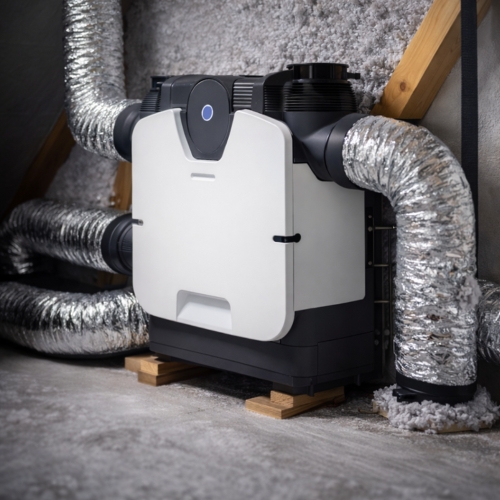
Controls and system management
Heating settings contribute to the operation of the system as a whole. Programming, temperature set points and controls must correspond to how the home is occupied. A house occupied continuously is not necessarily managed in the same way as a property used intermittently. Settings should therefore remain consistent with the building’s thermal inertia, the heated zones and the occupants’ requirements.

Typical situations in Ardennes
Stone house with an old oil boiler
In this generic situation, the project begins by assessing the building’s heat loss and the radiator circuit. If the loft is poorly protected, improving it can be considered before replacing the heat generator. The heat pump is then sized according to the planned condition of the property and the temperatures required by the retained emitters.
Already insulated detached house with central heating
A property that has already had work carried out on the roof, walls or windows may have different requirements from those it had originally. The existing water-based network may provide a basis for the project, subject to checking its condition and operating temperatures. The equipment is then selected according to the current characteristics of the house.
Rural home without a gas connection
In an area where several heating solutions are possible, a heat pump can be assessed as one of the available options. The decision nevertheless depends on the building envelope, available space, the distribution system and installation constraints. In Ardennes, the large volumes found in some houses make it particularly useful to assess requirements room by room or zone by zone beforehand.
Grants and funding
Depending on the type of heat pump, the situation of the property and the conditions applicable to the application, some installations may be eligible for MaPrimeRénov’, CEE (energy savings certificates), reduced VAT or éco-PTZ (zero-interest eco-loan). The criteria are not identical for every type of equipment or every household. Where the scheme requires it, using an RGE-certified professional is one of the conditions to be met for the relevant grant.
To assess your project and its different technical aspects, you can contact GRAM Énergie. The official criteria for schemes, support pathways and applicable requirements should be checked directly on France Rénov’. This verification makes it possible to build the financing around the rules in force without choosing equipment solely on the basis of a potential grant.
How we work

Assessment of the home
We examine the building layout, insulation, heated volumes and the system currently in place.

Assessment of requirements
Heat loss and thermal characteristics are used to define the requirements the new equipment must meet.

Checking the emitters
The network, radiators or underfloor heating are assessed to verify their compatibility with the proposed solution.

Definition of the system
The type of equipment, its location and its connection are determined according to the constraints identified.

Coordination of settings
Controls and system management are adapted to the use of the home and the operation of the installation.
Our other services in Ardennes
A heating project can form part of a broader approach with a global energy renovation in Ardennes, insulation in Ardennes, a thermodynamic water heater in Ardennes or an energy audit in Ardennes. You can also visit our page on energy renovation in Ardennes, our Grand Est page and the information dedicated to Charleville-Mézières.
Frequently asked questions
Is a heat pump suitable for an old stone house?
It can be considered, but the wall material alone is not enough to answer the question. Overall heat loss, the condition of the roof, floors, windows and the temperatures required by the emitters must all be assessed. An older, poorly insulated house may require a different approach from a property whose envelope has already been improved.
Should the loft be insulated before changing the heating system?
When the loft is responsible for significant heat loss, treating it beforehand can noticeably change the heating requirements that need to be considered. This makes it possible to assess the future equipment based on an envelope closer to its final condition. The order of work nevertheless depends on the building and should be defined after examining its configuration.
Can old radiators be retained with a heat pump?
Some radiators can be retained if their characteristics are compatible with the requirements of the home and the planned water temperatures. Their presence alone does not guarantee compatibility. Their sizing, the hydraulic network and the temperature required to maintain comfort when outdoor conditions become colder must all be checked.
Does the cold climate in Ardennes prevent heat pump installation?
The climate does not rule out the principle, but it makes correct sizing particularly important. The equipment must be assessed according to the building’s requirements as outdoor temperatures fall, its envelope and its heat distribution system. The preliminary assessment is precisely intended to check whether the proposed solution remains consistent with the home and how it is used.
Let’s talk about your project
Tell us about your home and your goals: we help you prioritise the works and identify the grants worth looking into.