

Energy Renovation in Hauts-de-France
Hauts-de-France has a largely older housing stock, shaped by brick, terraced town houses and the former workers’ and mining villages. The oceanic climate adds its own constraint: long winters, persistent damp and frequent wind that increases heat loss. Many homes in the region remain thermally inefficient, hard to heat and expensive to run. GRAM Énergie supports owners across the whole journey: reading the existing building, prioritising the works, coordinating the contractors and preparing the grant applications. The aim does not change from one département to the next: gain comfort, cut consumption and preserve the value of the home.
Tip: have your energy performance certificate (DPE) and energy bills to hand for a more accurate estimate.
The building stock of Hauts-de-France and its energy challenges
Brick dominates the regional landscape. Narrow-fronted town houses, terraced houses, former corons (miners’ terraced cottages) and post-war suburban homes share the same construction logic: solid walls, built without a cavity or insulation. These walls store heat but let it escape as soon as the heating stops. Many of these homes were built before any thermal regulations existed. Lofts have sometimes received only a thin layer laid a long time ago, now compressed and no longer effective. The roof, the walls and the windows therefore account for most of the heat loss. In town-centre apartment blocks, the issue shifts to the communal areas and the roof, with decisions that have to be taken collectively.
The climate weighs on the final result. Winters are long, the heating season is drawn out, and moisture-laden wind strikes the exposed façades. Driving rain soaks the brickwork, cold air seeps in through gaps in the air barrier, and homes cool down quickly. This combination explains the number of thermally inefficient homes in the region. It also explains why ventilation cannot be handled as an afterthought: making a home airtight without organising air renewal simply shifts the problem towards condensation and mould. North-west-facing façades, the most exposed to the prevailing winds, cool faster than the others and deserve close attention during the technical survey.
The industrial heritage adds a particular dimension. The former workers’ and mining villages bring together repetitive homes, often modest in floor area, with poorly insulated loft spaces and ageing heating systems. Gas serves the densely built areas, while oil-fired heating persists in rural communes. These households frequently fall among the groups targeted by the enhanced renovation grants. A well-ordered renovation produces rapid comfort gains there, provided the building envelope is treated before the equipment. Summer comfort is starting to count too: under a poorly insulated loft, heat builds up from the first muggy days.
Our services in Hauts-de-France
Whole-house energy renovation
Treating the home as a whole gives the best results on the regional building stock. A whole-house energy renovation combines insulation, heating and ventilation in a coherent order, rather than stacking up isolated measures. On a brick house, this approach avoids the most common mistakes: replacing the boiler before insulating, or reworking the walls without reviewing air renewal.
Heat pump
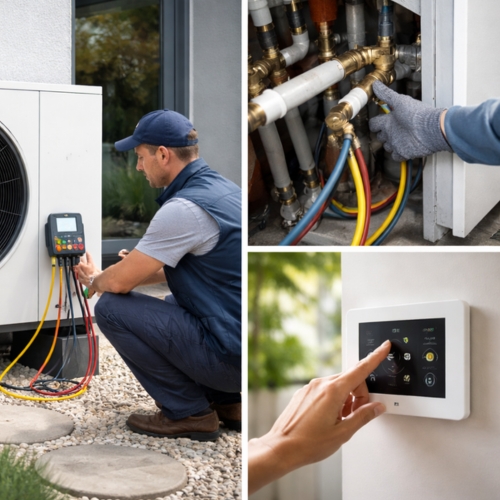
Replacing an old boiler with a heat pump changes the way a home is heated. The region’s long winters call for rigorous sizing: an undersized unit falls back on its back-up heating too often, while an oversized one wears out prematurely. We check the insulation, the existing emitters and the location of the outdoor unit.
Insulation
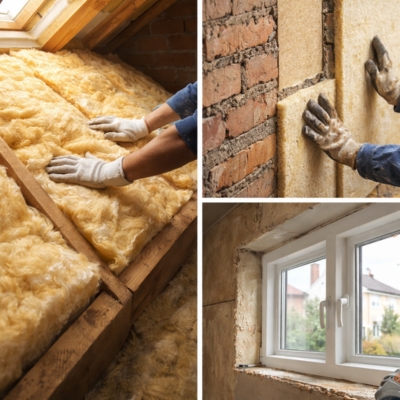
Insulation remains the first lever on a predominantly older housing stock. The loft is treated as a priority, then the walls and the windows. On solid brick walls, the choice between internal and external insulation depends on the appearance of the façade, on whether the house is terraced and on local planning rules. We also study how the wall behaves with moisture.
Thermodynamic water heater
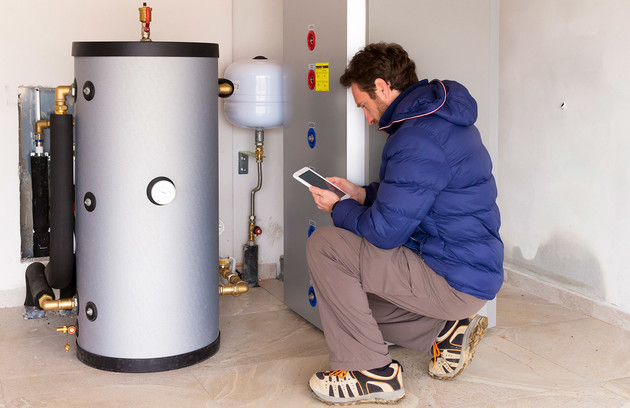
Domestic hot water weighs heavily on the annual bill. The thermodynamic water heater draws its energy from the ambient air and uses markedly less than a conventional electric cylinder. Its installation calls for a sufficient volume of air and a condensate drain: a garage, store room or utility room is often suitable in the region’s houses.
Energy audit
An energy audit sets an objective starting point. It describes the heat losses, the thermal bridges, the condition of the heating and the ventilation, then proposes scenarios of works in order of priority. On an older brick building, this reading avoids decisions taken at random and secures the grant applications.

Mechanical ventilation (VMC)
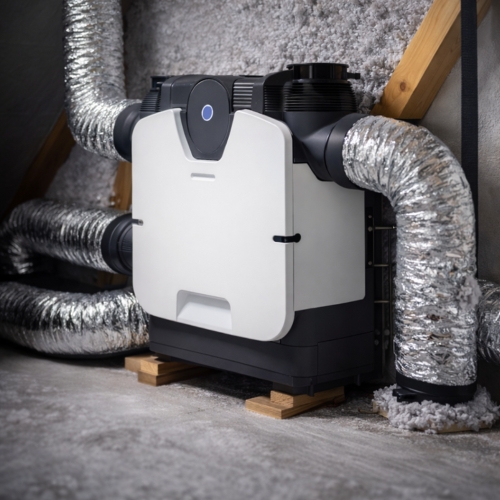
Ventilation is too often forgotten. A home made airtight by new windows and effective insulation still has to expel the moisture produced day to day. In a damp climate, the absence of air renewal quickly turns into condensation and mould. We install and upgrade controlled mechanical ventilation systems, in step with the other works.
Smart thermostat
Controlling the temperature precisely avoids heating unoccupied rooms. The smart thermostat adjusts the settings to the household’s timetable and actual habits, and makes it possible to follow consumption through the heating season. On an existing central heating system, this fine-tuning extends the effect of the insulation works without altering the installation.
The départements we cover
We work across the whole of Hauts-de-France, from the dense communes of the Lille metropolitan area to the rural market towns of Picardy and the coastline of the Channel and the North Sea. Each département has its own dedicated page, with the detail of the local building stock and the communes concerned.
- Nord (59): the dense Lille metropolitan area, terraced brick town houses, courées (courtyard housing) and former workers’ villages, with a strong presence of pre-1948 buildings.
- Pas-de-Calais (62): the mining basin, rural communes and a wind-exposed coastline, with poorly insulated lofts and oil-fired heating still common.
- Somme (80): older Picardy building stock, brick houses and scattered rural housing, where damp and ventilation call for constant attention.
- Aisne (02): a rural area of old market towns and houses in brick or stone, often heated by oil far from the gas network.
- Oise (60): a département on the fringes of the Paris region, between recent suburban homes, old town centres and brick houses in need of complete insulation.
Grants and financing for your works
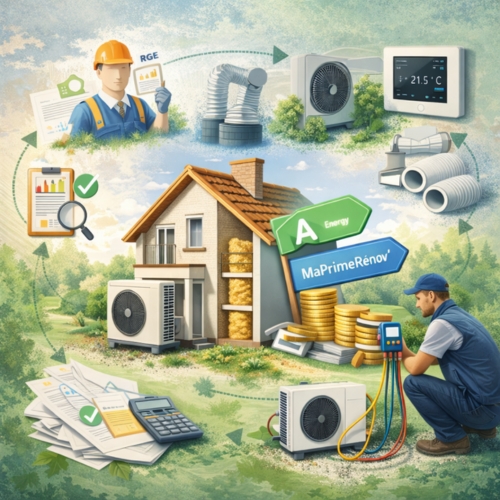
Several public schemes support home renovation in Hauts-de-France: MaPrimeRénov’, the main French state renovation grant, the certificats d’économies d’énergie (CEE), energy saving certificates financed by energy suppliers, the reduced rate of TVA (French VAT) on energy improvement works and the éco-prêt à taux zéro (éco-PTZ), an interest-free renovation loan. Low-income households receive enhanced support, which concerns a notable share of owners in the region. The conditions depend on the home, on the works and on the household’s situation. Combining several schemes remains possible in certain cases, according to the rules specific to each.
We prepare the technical documents required and point you towards the right contacts. The public service France Rénov’ lists the schemes in force and their conditions.
Applications are prepared before the works begin.
How a project runs with GRAM Énergie

First conversation
You describe the home, the discomfort you experience and your objectives. We frame the need and the feasibility.
Technical survey on site
A record of the building, the walls, the loft, the windows, the heating and the ventilation.

Costed, prioritised proposal
We set out the works, their logical order and the comfort gains to expect.
Administrative preparation
Assembling the grant applications and checking the documents before work starts.

Delivery and follow-up
Coordinating the trades, checking the critical points, handing over the completed works and explaining the settings.
Frequently asked questions
Do you work in every département of Hauts-de-France?
Yes. We cover Nord, Pas-de-Calais, Somme, Aisne and Oise. Depending on the commune and the nature of the works, the organisation of the project differs a little, particularly between dense urban centres and rural areas. A first conversation makes it possible to clarify the conditions at your address.
Which works should come first on a brick house?
The building envelope. The loft is treated first, because heat loss through the top of the house is significant and the operation remains simple. Then come the walls and the windows, and finally the heating system. Replacing the boiler first often leads to oversizing the equipment and compensating for a lack of insulation.
Is a terraced house renovated in the same way as a detached one?
No. Party walls exchange little heat with the outside: the effort goes into the front and rear façades, the exposed gable ends and the roof. Site access also calls for more organisation on a narrow street. These constraints are common in the region and are handled case by case.
Is an energy audit needed before starting the works?
It is not systematic, but it is useful as soon as the project goes beyond a single measure. The audit puts the priorities in order, compares the scenarios and secures the grant applications. For a major renovation of an older home, it provides a solid basis for discussion between you and the contractors.
Is damp an obstacle to insulation in the region?
It calls for method. A damp wall must be diagnosed and treated before it is insulated, otherwise water is trapped inside it. Ventilation has to follow any airtightness works. In the oceanic climate of Hauts-de-France, these two points determine how durable the result will be.
Do you have an energy renovation project in Hauts-de-France? Describe your home and your objectives through our contact form: we reply with an initial reading of your situation and the steps to consider.
Let’s talk about your project
Tell us about your home and your goals: we help you prioritise the works and identify the grants worth looking into.