

Global energy renovation in Pas-de-Calais (62)
A global energy renovation in Pas-de-Calais (62) involves coordinating several types of work rather than addressing each system separately. Insulation, heating, ventilation and hot water production are assessed in a coherent order, according to the existing property. This approach is particularly relevant in a department where mining-era brick houses, coastal homes exposed to wind and humidity, and rural properties still heated with oil all coexist. The aim is to build a programme suited to the building, its use and the technical constraints of the property.

Tip: have your energy performance certificate (DPE) and energy bills to hand for a more accurate estimate.
Why carry out a global energy renovation in Pas-de-Calais
In workers’ estates and terraced houses, party walls reduce some heat loss to the sides, but lofts, gable walls, floors and older windows can remain vulnerable areas. Replacing only the heating system without examining these elements may result in sizing new equipment for a home that still has significant heating needs. A global approach instead makes it possible to prioritise improvements before choosing the technical systems.
On the coast, the project also needs to account for driving rain, wind, sea spray and air renewal. A home made more airtight after improvements to its envelope must retain suitable ventilation to limit condensation. In rural parts of Pas-de-Calais, replacing an oil boiler with a heat pump may form part of the programme, but only after checking the insulation, heat emitters and thermal characteristics of the building.
What a global energy renovation includes
Assessment of the building envelope
A global energy renovation begins with an assessment of the main areas of heat loss: roof, loft, external walls, gable walls, ground floors and windows. This review helps identify priorities and avoids replacing a heating system too early, before the building’s energy needs have been reduced.
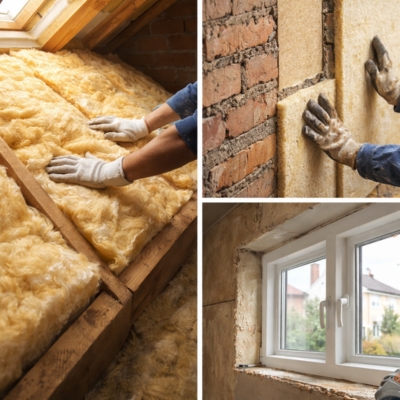
Defining the insulation work
The solutions selected depend on the layout of the property. Accessible lofts are not treated in the same way as converted roof spaces, and a brick façade exposed to the weather does not lead to the same choices as a protected wall between two adjoining houses. Materials, continuity of insulation and the treatment of junctions must be considered together.
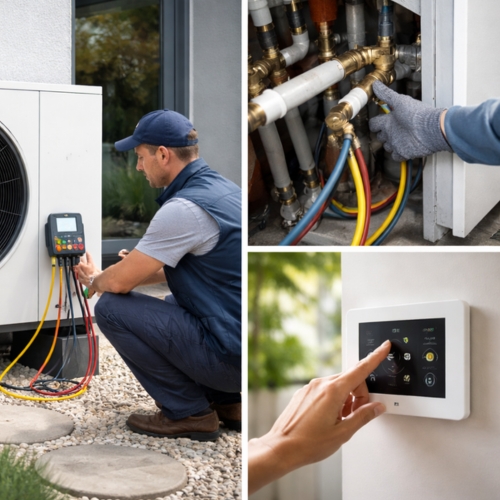
Adapting the heating system
Once the envelope has been assessed, the heating system can be studied according to the home’s actual needs. The required output, existing hydraulic network, radiators or underfloor heating and operating temperatures all influence the choice of equipment. In a rural house, for example, the presence of an older oil boiler is a situation that needs to be considered as part of the whole system.
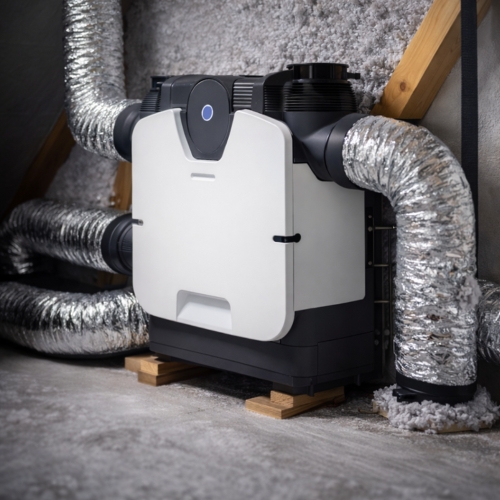
Ventilation and air renewal
Improving airtightness without properly organising the removal of moisture can shift problems rather than solve them. Ventilation is therefore included in the assessment, particularly in homes exposed to a humid climate or where windows are being replaced. Air inlets, extraction points and airflow between rooms must remain compatible with the other improvements.
Domestic hot water and system compatibility
Hot water production is another area that can be coordinated with the rest of the project. The choice depends on the existing installation, available space, household use and the other systems selected. The aim is not to accumulate equipment, but to create a technically compatible arrangement suited to the property.

Typical situations in Pas-de-Calais
Terraced house from the mining-era housing stock
In a brick home adjoining neighbouring properties on both sides, the assessment may prioritise the loft, the gable wall where one exists, the windows and the ventilation. The heating system can then be reconsidered after the envelope has been improved, rather than replaced independently.
House located near the coast
In Calais, Boulogne-sur-Mer or a comparable coastal town, exposure to wind and rain means particular attention must be paid to façades, windows and outdoor equipment. Improving airtightness should remain associated with controlled air renewal to prevent persistent indoor humidity from concentrating in certain areas.
Rural home heated with oil
In inland parts of the department, a home away from the gas network may combine a poorly insulated roof, older walls and an ageing heating system. The programme can then be structured in a technically coherent sequence: reducing energy needs, checking heat emitters, assessing a new system and adapting the ventilation.
Grants and funding
Depending on the project and the conditions applying to the application, a global renovation may qualify for schemes such as MaPrimeRénov’, CEE (energy savings certificates), reduced VAT or the éco-PTZ (zero-interest eco-loan). The criteria differ between schemes, and some grants require the work concerned to be carried out by an RGE-certified professional. Eligibility should therefore be checked before the final programme is approved.
You can contact GRAM Énergie to present the characteristics of your property and the areas you are considering. To check the official rules, eligibility conditions and the route that applies to your situation, you can also consult the official France Rénov’ website before making any commitment.
How we work

Property assessment
We gather information about the building, existing systems, usage, access constraints and the aims of the project.

Prioritising the areas of work
The envelope, ventilation, heating and hot water are reviewed to identify which improvements should be addressed first.

Building the renovation scenario
The different operations are organised in a compatible order so that a decision on one area does not complicate the next.
Checking the systems
The proposed equipment is assessed against the characteristics of the building, the existing heat emitters and the installation conditions.

Preparing the project
The selected programme is defined with its different components, the technical constraints identified and any procedures connected with grants.
Our other services in Pas-de-Calais
Depending on the need identified, you can also consult our pages on heat pumps in Pas-de-Calais, insulation, thermodynamic water heaters and energy audits. You can also find the departmental energy renovation page, the Hauts-de-France page, as well as local information for Calais and Boulogne-sur-Mer.
Frequently asked questions
Should you start by replacing the heating system in an older house?
Not necessarily. If the roof, external walls or windows still have significant weaknesses, it is generally preferable to assess these areas before sizing a new system. The choice of heating should take into account the needs of the property after the planned improvements to the envelope.
Does a terraced house still require a global renovation?
Party walls reduce some exposed surfaces but do not remove the other areas of concern. A terraced house may still lose heat through the roof, floor, front façade, rear façade or a gable wall. Ventilation and technical systems must also be assessed according to the actual condition of the property.
Why include ventilation in work carried out near the coast?
Better insulation and new windows reduce uncontrolled air leakage. In a humid environment exposed to the weather, indoor air renewal therefore becomes an essential part of the project. Ventilation should be considered alongside the envelope to ensure that moisture produced inside the home is removed regularly.
Can a heat pump be included in a global project in a rural area?
Yes, if the characteristics of the building and the existing system allow it. The insulation, heating needs, type of heat emitters, their operating temperature and the options for outdoor installation must all be assessed. This prevents the heat pump from being selected separately from the rest of the programme.
Let’s talk about your project
Tell us about your home and your goals: we help you prioritise the works and identify the grants worth looking into.