

Energy audit in Pas-de-Calais (62)
An energy audit in Pas-de-Calais (62) makes it possible to assess the property as a whole before defining the work. It is not limited to heating: the building envelope, ventilation, equipment and household use are examined to identify the areas that have the greatest influence on the building’s energy performance. This approach is particularly useful in a department where mining-era brick houses, coastal homes exposed to humidity and rural properties heated with oil present different constraints. The audit therefore helps prioritise improvements and compare several coherent renovation scenarios.

Tip: have your energy performance certificate (DPE) and energy bills to hand for a more accurate estimate.
Why carry out an energy audit in Pas-de-Calais
In former workers’ estates, the assessment of the building must take account of party walls. Walls shared with neighbouring properties do not present the same issues as the roof, front and rear façades or an exposed gable wall. Lofts with little insulation, or insulation installed a long time ago, may also have a greater impact on the assessment than certain side walls. The audit helps distinguish priority areas rather than applying the same solution to every surface.
On the Pas-de-Calais coast, the assessment must also take account of exposure to wind, driving rain and humidity. Improving airtightness without sufficient air renewal can encourage condensation in certain areas. In rural locations, the audit can notably be used to assess replacing an oil-fired heating system while taking account of the insulation and existing heat emitters. The aim is to check the logical order of the work before selecting new equipment.
What the energy audit includes
Assessment of the building and its envelope
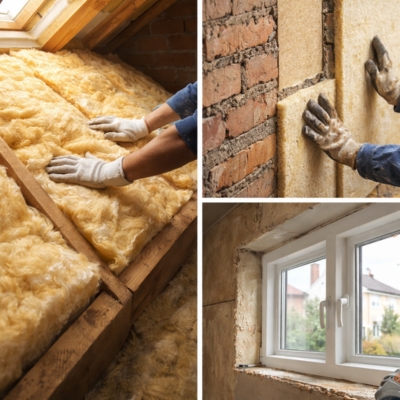
The energy audit begins with an assessment of the construction: walls, roof, loft, floors, windows and the main junctions. The type of materials, party walls, exposed surfaces and visible condition of the building fabric help provide a clearer understanding of the vulnerable areas and the improvements that can be considered.

Assessment of heating and hot water
The heating unit, radiators or underfloor heating, controls and hot water production are assessed together with the rest of the property. An older boiler should not be considered independently of the quality of the building envelope. The assessment also covers the compatibility of the heat emitters with a possible change of system and the overall organisation of the equipment.

Checking ventilation
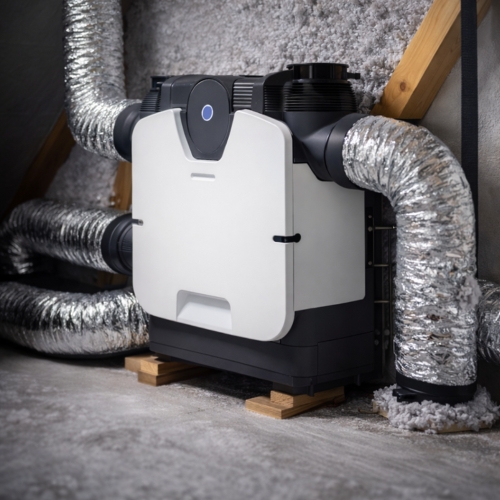
Air renewal is assessed to determine how moisture produced inside the property is removed. Air inlets, extraction vents, airflow between rooms and the general operation of the system are taken into account. This stage is particularly important when insulation work or window replacement is being considered.
Developing renovation scenarios
An audit is not simply a list of possible improvements. The work is grouped into scenarios that follow a coherent technical order. It may, for example, be appropriate to improve certain parts of the envelope before sizing a new heating system. The different solutions are compared to show how they interact and how one decision may affect subsequent stages.
Prioritising the work
Each property has its own constraints. The audit helps distinguish what should be addressed as a priority from what can be included in a later phase. This prioritisation takes account of the building, existing equipment and the overall coherence of the project, without assuming that the same package of work is suitable for every home.
Typical situations in Pas-de-Calais
Mining-era house with older loft insulation
In a terraced property, the audit may show that the roof and exposed façades deserve more attention than the side walls. It can also be used to assess the condition of the windows, ventilation and heating before establishing a coherent order of work across the different areas.
Coastal house with condensation
In Calais, Boulogne-sur-Mer or a comparable coastal town, the assessment should not automatically attribute humidity to insufficient insulation. The audit examines outdoor exposure, the condition of the walls, ventilation and cold areas to understand how they interact before proposing a renovation scenario.
Rural property heated with oil
A house located away from the gas network may require both improvements to its envelope and a change to its heating system. The audit is then used to assess the needs, condition of the radiators, loft, walls and floors before considering a heat pump or another compatible solution.
Grants and funding
Depending on the renovation route, the characteristics of the property and the work selected following the audit, MaPrimeRénov’, CEE (energy savings certificates), reduced VAT or the éco-PTZ (zero-interest eco-loan) may be available where they apply to the planned improvements. Conditions differ between schemes and some grants impose specific requirements, including the use of an RGE-certified professional for the work concerned.
You can contact GRAM Énergie to present your property and the renovation objectives you would like to assess. To check the official rules, eligibility conditions for the schemes and the procedures that apply to your situation, you can also consult the public France Rénov’ service before making any commitment.
How we work

Gathering information
We collect the available information about the property, its equipment, materials and any work already carried out.

Assessing the building
The surfaces, windows, ventilation, heating and hot water production are analysed in their current configuration.

Identifying vulnerable areas
The main areas for improvement are prioritised according to their role in the overall performance of the property.
Developing scenarios
Several combinations of work can be organised to compare coherent renovation routes and the order in which they can be carried out.

Preparing the next stage of the project
The findings provide a basis for defining technical solutions, checking applicable grants and preparing the selected work.
Our other services in Pas-de-Calais
After assessing the property, you can consult our pages on global energy renovation, heat pumps, insulation and thermodynamic water heaters. You can also find the energy renovation in Pas-de-Calais page, the regional Hauts-de-France page, as well as content dedicated to Calais and Boulogne-sur-Mer.
Frequently asked questions
Is an audit useful if I already know which work I want to carry out?
Yes, because it helps check whether the planned order is coherent with the way the property performs. Replacing the heating system before carrying out insulation work, for example, may lead to the sizing being reconsidered. The audit places each decision within an overall scenario rather than simply confirming the choices already being considered.
Can the audit show whether the walls of a terraced house need insulating?
It mainly makes it possible to compare their importance with that of other exposed surfaces. In a terraced house, walls shared with neighbouring properties may be less of a priority than the roof, façades or a gable wall. The decision depends on the actual configuration of the property and cannot be determined from the building type alone.
Is ventilation included in an energy audit?
Yes, because renovating the envelope changes the way air moves through the property. The condition of air inlets, extraction points and airflow between rooms must be assessed alongside the insulation. This is particularly important in homes exposed to humidity or where signs of condensation are already present.
Can an audit prepare for replacing an oil boiler?
Yes. It can be used to assess replacement of the heating unit while taking account of the building’s needs after the planned improvements. The condition of the radiators, insulation and characteristics of the network are assessed before a new solution is selected. This avoids choosing equipment without knowing the property’s future requirements.
Let’s talk about your project
Tell us about your home and your goals: we help you prioritise the works and identify the grants worth looking into.