

Energy audit in Nord (59)
An energy audit in Nord (59) helps you understand the thermal behaviour of a home before carrying out major work. It does not simply record the systems already in place: it examines the building envelope, heating, ventilation, hot water and the interactions between these different areas. In a department where brick terraced houses, former workers’ homes and older buildings remain common, this assessment helps distinguish genuinely significant weaknesses from secondary issues. It can then be used to develop several improvement scenarios that are consistent with the building, how it is used and its technical constraints.

Tip: have your energy performance certificate (DPE) and energy bills to hand for a more accurate estimate.
Why carry out an energy audit in Nord
Older housing in Nord requires a precise assessment. A deep-plan house with a front façade, rear façade and two party walls does not behave in the same way as a detached house exposed on all four sides. The roof, exposed gables, windows or certain floors may account for a significant share of heat loss. The audit puts each element into context without automatically assigning the same importance to every wall or surface.
The department’s humid and windy climate also makes it necessary to assess airtightness, surface temperatures and air renewal together. A cold room may result from an exposed wall, a poorly sealed window, uneven heat distribution or several combined causes. In Nord, the assessment is specifically intended to avoid drawing conclusions too quickly before defining a renovation programme.
What an energy audit includes
Assessing the building envelope
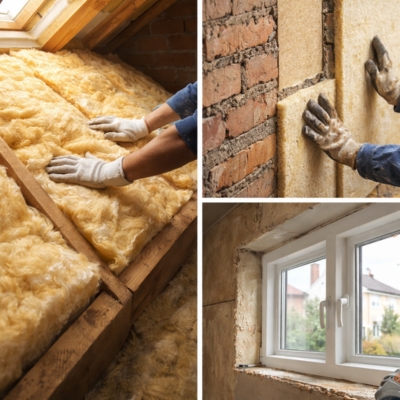
The national page on the energy audit explains the role of this study within a renovation project. The assessment notably covers walls, the roof, floors, openings and the different surfaces in contact with the outside or unheated spaces. The nature of the materials and the configuration of the property are taken into account when identifying the main weaknesses.

Assessing the heating system
The heat generator, radiators or other emitters, controls and heat distribution are assessed together. In homes fitted with older gas boilers, it is useful to distinguish what relates to the generator from what depends on the building envelope or the network. An older appliance does not automatically mean that replacing it should be the first step in the scenario.

Examining the ventilation
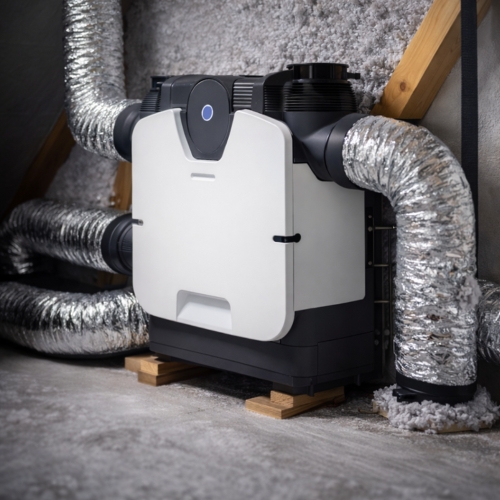
Air renewal directly affects how the home performs. The audit checks the existing ventilation systems, air inlets, extract points and airflow between rooms. In a home renovated in stages, replaced windows or removed grilles may have altered the original balance. These factors are included in the assessment before further improvements are proposed.
Developing work scenarios
The measures are grouped into coherent scenarios rather than presented as a simple list. Their sequence takes account of the interactions between insulation, ventilation, heat production and hot water. A scenario may therefore include treating certain building elements before resizing heating equipment. The aim is to avoid contradictory work or choices that would later need to be revised.
Identifying the property’s constraints
Technical feasibility does not depend solely on the performance sought. A façade aligned with the street, limited internal width, difficult-to-access lofts or a small technical room can restrict certain solutions. The audit takes these constraints into account so that the proposed options remain compatible with the actual configuration of the building and with the other work being considered.
Typical situations in Nord
Brick terraced house before renovation
The property has two exposed façades, older loft space and a gas boiler. The audit does not assume that all walls need to be treated. It distinguishes party walls from surfaces facing outside, assesses the roof and examines the systems before establishing the possible sequence of improvements.
Former workers’ house renovated in stages
The windows have been replaced, but the loft and walls have not been treated in the same way. The ventilation may also have changed without overall coordination. The assessment helps reconstruct this sequence of alterations in order to identify any inconsistencies and propose a programme that takes the existing situation into account.
Urban home with limited options for intervention
In Lille or Dunkerque, one façade may face directly onto the street while the rear opens onto a narrow courtyard. Certain solutions can therefore be more difficult to implement. The assessment compares the different options while taking account of available space, access, façade constraints and possible technical routes.
Grants and funding
Depending on the project and the applicable rules, an audit can form part of a pathway involving MaPrimeRénov’, CEE (energy savings certificates), reduced VAT or the éco-PTZ (zero-interest eco-loan) where these schemes apply to the work that follows. The conditions are not the same for every mechanism. Certain measures or pathways also impose specific requirements concerning performance or the use of RGE-certified professionals.
You can contact us to clarify the property to be assessed, the alterations already carried out and the work being considered. To check the official rules concerning grants, supported pathways and requirements applying to your situation, you can also consult the public service website France Rénov’.
How we work

Gathering information
We record the characteristics of the property, existing systems, work already completed and the main patterns of use.
Assessing the building
The walls, roof, floors, openings and different exposed areas are examined according to their actual configuration.
Reviewing the systems
Heating, hot water, controls and ventilation are considered within the overall operation of the home.
Developing scenarios
Several packages of improvements are structured in a coherent sequence so that the different possible approaches can be compared.

Presenting the findings
The weaknesses, priorities and identified constraints are set out to help prepare the next stage of the project.
Our other services in Nord
The audit can prepare the way for several types of work. You can also consult our pages on global energy renovation in Nord, heat pumps, insulation and thermodynamic water heaters. You can also consult the department energy renovation page, the Hauts-de-France page, as well as our content for Lille and Dunkerque.
Frequently asked questions
Is an audit useful before replacing a boiler?
Yes, when the replacement forms part of a broader project. The assessment helps determine whether the property’s needs could change after work on the roof, walls or windows. It therefore avoids reasoning solely from the old appliance and helps place the heating system within the project as a whole.
Does the audit take party walls into account?
Yes. A wall adjoining a heated neighbouring home is not assessed in the same way as an external façade. In the department’s town houses, this distinction can significantly change the interpretation of heat loss and priorities. The assessment therefore considers the immediate environment of each wall rather than looking only at its surface area.
Can a partially renovated home still be audited?
Yes. This can be particularly useful when several improvements have been carried out at different times. The audit then examines the elements retained, those that have been altered and the interactions between them. It can reveal inconsistencies between the envelope, ventilation and systems in order to organise the next stages more effectively.
Does the audit require you to follow a specific scenario afterwards?
No. Its role is to structure and compare renovation options based on the condition of the property. Technical constraints, the available budget, occupancy of the home and the owner’s priorities still need to be taken into account before deciding which work will actually be carried out.
Let’s talk about your project
Tell us about your home and your goals: we help you prioritise the works and identify the grants worth looking into.