

Energy Renovation in Nord (59)
Nord concentrates a dense and older housing stock, shaped by the Lille metropolitan area and by the industrial history of the territory. Terraced brick town houses with narrow frontages, courées (courtyard housing) and former workers’ villages: this pre-1948 building stock is very present and was rarely insulated when built. Solid walls, neglected lofts and ageing gas boilers weigh on the bill as much as on comfort. GRAM Énergie supports owners in the département from the first visit to the handover of the completed works: reading the building, ordering the works, coordinating the trades and preparing the grant applications. Every home is studied for what it is, never according to a standard model.
Tip: have your energy performance certificate (DPE) and energy bills to hand for a more accurate estimate.
The building stock of Nord and its energy challenges
The terraced town house dominates the landscape of Nord. A narrow frontage on the street, a deep floor plan, solid brick walls built without insulation: pre-1948 construction remains strongly represented in the département. These walls let heat escape as soon as the heating stops. The courées and former workers’ villages extend the same logic with homes that are smaller still, aligned in terraces, whose lofts have often received only a thin layer of insulation, today compressed and ineffective.
Heating follows the same heritage. Gas serves much of the Lille metropolitan area and the densely built communes, often through boilers installed long ago and paired with oversized radiators. Original windows, or windows replaced without any serious attention to airtightness, let air through. In a damp and windy climate, these accumulated shortcomings produce homes that are hard to heat and prone to condensation, particularly in the least ventilated rooms.
The urban context adds its own constraints. In a dense centre, site access, parking and the delivery of materials have to be prepared in advance. External wall insulation sometimes runs up against the building line on the street and against heritage rules. Party walls, for their part, exchange little heat with the outside: the effort goes into the front and rear façades, the exposed gable ends and the roof. This reasoning guides every one of our proposals in Nord.
Our services in the 59
Whole-house energy renovation
Treating the home as a whole gives the best results on this older building stock. A whole-house energy renovation combines insulation, heating and ventilation in a coherent order, rather than stacking up isolated measures. On a brick town house, this approach avoids the most common mistake: replacing the boiler before the building envelope has been dealt with.

Heat pump
Replacing an ageing boiler with a heat pump calls for rigorous sizing. We check the existing insulation, the emitters in place and the location of the outdoor unit, which is often constrained on the narrow, terraced plots of the département. A correctly calibrated unit limits the use of back-up heating through the long winters.

Insulation
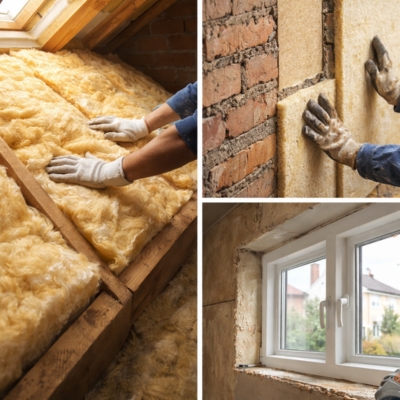
Insulation remains the first lever on this older housing stock. The loft is treated as a priority, then the walls and the windows. On solid brick walls, the choice between internal and external insulation depends on whether the house is terraced, on the appearance of the façade and on the planning rules of the commune concerned.
Thermodynamic water heater
Domestic hot water weighs heavily on the bill. The thermodynamic water heater draws its energy from the ambient air and uses markedly less than an electric cylinder. Its installation calls for a sufficient volume of air and a condensate drain: a store room, garage or utility room is often suitable in the houses of the département.

Energy audit
An energy audit sets an objective starting point. It describes the heat losses, the condition of the heating and the ventilation, then proposes scenarios of works in order of priority. On a pre-1948 home, this reading avoids decisions taken at random and secures the grant applications.

Mechanical ventilation (VMC)
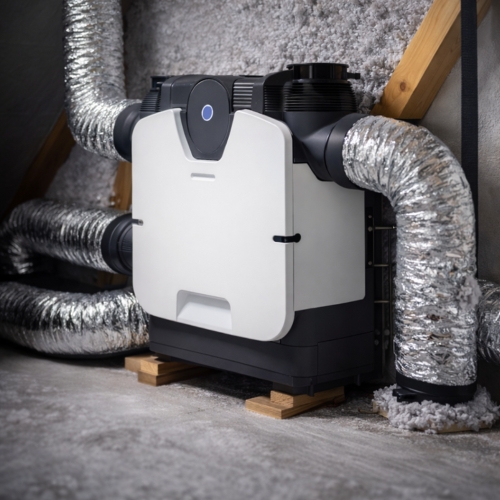
Ventilation cannot be handled as an afterthought. A home made airtight by new windows must expel the moisture produced day to day, otherwise condensation appears on the cold surfaces. We install and upgrade controlled mechanical ventilation systems, in step with the other works undertaken.
Smart thermostat
Controlling the temperature precisely avoids heating unoccupied rooms. The smart thermostat adjusts the settings to the household’s actual timetable and makes it possible to follow consumption through the heating season. On an existing central heating system, this fine-tuning extends the effect of the insulation works.
The towns we work in across the 59
We work across the whole département, from the communes of the Lille metropolitan area to the towns of the Valenciennois, the Douaisis and the Cambrésis, as far as the Dunkerque coastline. You can also visit our energy renovation in Hauts-de-France page.
- Lille: narrow-fronted brick town houses, often terraced, where internal insulation and the roof concentrate the gains.
- Roubaix: dense working-class districts, courées and terraced houses whose solid walls and lofts call for priority treatment.
- Tourcoing: comparable older building stock, with narrow, deep homes where ventilation must accompany every airtightness measure.
- Dunkerque: a coastline exposed to wind and sea spray, with windows under heavy strain and façades subject to constant damp.
- Villeneuve-d’Ascq: suburban houses and residential blocks from the 1960s to the 1980s, classic candidates for loft insulation and a change of heating.
- Douai: an old centre and brick faubourgs, with terraced houses whose exposed gable ends deserve particular attention.
- Valenciennes: housing that mixes an old centre, post-war reconstruction and former workers’ estates, where replacing old boilers comes up often.
- Wattrelos: terraced houses inherited from the textile past, with poorly insulated lofts and ageing heating systems.
- Marcq-en-Barœul: more spacious detached houses, for which the heat pump is sized once the building envelope has been dealt with.
- Cambrai: older brick building stock and nearby rural areas, where the energy audit helps to prioritise the works to undertake.
Grants and financing for your works
Several public schemes support home renovation in Nord: MaPrimeRénov’, the main French state renovation grant, the certificats d’économies d’énergie (CEE), energy saving certificates financed by energy suppliers, the reduced rate of TVA (French VAT) on energy improvement works and the éco-prêt à taux zéro (éco-PTZ), an interest-free renovation loan. The conditions depend on the home, on the nature of the works and on the household’s situation. Combining several schemes remains possible in certain cases.
We prepare the technical documents required and point you towards the right contacts. The public service France Rénov’ lists the schemes in force and their conditions.
Applications are prepared before the works begin.
How a project runs with GRAM Énergie

First conversation
You describe the home, the discomfort you experience and your objectives. We frame the need and the feasibility.

Technical survey on site
A record of the building, the walls, the loft, the windows, the heating and the ventilation.

Costed, prioritised proposal
We set out the works, their logical order and the comfort gains to expect.
Administrative preparation
Assembling the grant applications and checking the documents before work starts.

Delivery and follow-up
Coordinating the trades, checking the critical points, handing over the completed works and explaining the settings.
Frequently asked questions
Can a town house in Nord be insulated externally?
Not always. On a narrow façade aligned with the street, external wall insulation changes the appearance of the building and sometimes encroaches on public land. Local planning rules decide the matter. We check this point in advance. Internal insulation combined with the loft and the windows then delivers a serious result.
How does a project run in a dense urban centre?
It is prepared. Parking, the delivery of materials and access to the courées require precise organisation and suitable time slots. We anticipate these constraints from the technical survey onwards, because they are common in Lille, Roubaix and Tourcoing. The project then stays manageable for you and for the neighbours alike.
Should an old gas boiler be replaced before insulating?
No, unless it has broken down. Insulation reduces the heating demand first. The new equipment can then be sized as tightly as possible, which avoids paying for an oversized machine. In this département, that order is all the more useful because many older homes remain poorly insulated.
Is a heat pump suitable for a brick house?
Often yes, provided the building envelope is treated and the emitters are checked. In a poorly insulated home, the unit runs at high temperature and loses part of its benefit. The location of the outdoor unit also calls for thought on the narrow, terraced plots of Nord.
Do you work in every commune of the 59?
We work across the whole département, from the Lille metropolitan area to the Cambrésis and the Valenciennois, as well as on the Dunkerque coastline. Depending on the address and the nature of the works, the organisation of the project varies slightly. A first conversation makes it possible to clarify the conditions at your home.
Do you have an energy renovation project in Nord? Describe your home and your objectives through our contact form: we reply with an initial reading of your situation and the steps to consider.
Let’s talk about your project
Tell us about your home and your goals: we help you prioritise the works and identify the grants worth looking into.