


Insulation in Moselle (57)
Insulation in Moselle (57) must be designed according to the nature of the building, its exposure and the materials already present. Terraced houses from former mining areas, stone or brick homes and apartment buildings do not have the same priorities. Roofs, gable walls, ground floors, walls and windows must be assessed as a whole to limit heat loss without creating moisture-related problems. Well-designed insulation also prepares the home for possible changes to the heating or ventilation system.
Tip: have your energy performance certificate (DPE) and energy bills to hand for a more accurate estimate.
Why insulate in Moselle
In former mining and steelmaking communities, party walls reduce heat transfer through certain side walls, but lofts, exposed gables and windows can remain sensitive areas. The heating season in Grand Est makes these points particularly important to assess. Targeted work therefore begins by identifying which surfaces are genuinely in contact with the outside or with unheated spaces.
Older buildings found in Moselle require a different approach. Massive stone or brick walls can contain and transfer moisture. Internal insulation that is too airtight may disturb this balance. In historic centres where the appearance of façades must be preserved, internal wall insulation may become necessary, with careful treatment of junctions between walls, floors, windows and partitions.
What insulation includes
Loft and roof insulation
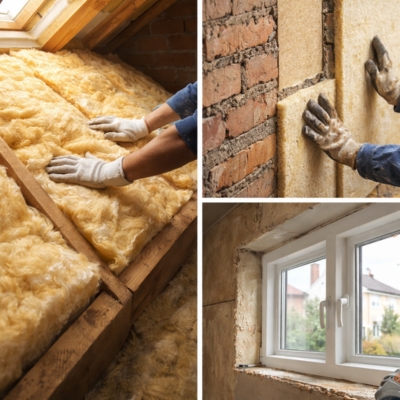
Insulation work often begins with the roof when it forms a significant boundary between the heated space and the outside. Unconverted lofts, converted roof slopes and attic floors require different solutions. The condition of the roof structure, roof ventilation, access and the presence of services must be checked before the insulation build-up is defined.
Wall insulation
Walls can be insulated internally or externally depending on the building’s configuration, planning rules and the condition of the façades. On older walls, compatibility between the insulation, substrate and finish is crucial. Window reveals, junctions with floors and internal load-bearing walls must be assessed to limit thermal bridges.

Ground-floor insulation
A floor above a cellar, basement or unheated void can contribute to heat loss from the home. Insulation may be installed from below where access and the nature of the substrate allow, or using another method suited to the existing floor. In houses with vaulted cellars, geometry and moisture levels directly influence the solution.

Windows and continuity of the envelope
Window replacement should not be considered independently from the walls. The position of the frames, perimeter airtightness and junctions with the insulation influence the continuity of the envelope. A high-performance window installed in a poorly treated wall does not eliminate thermal bridges around the reveal. The whole assembly must therefore be designed as a continuous system.

Ventilation and moisture management
Improving insulation changes the way the home behaves and can reduce uncontrolled air leakage. Ventilation must therefore be checked to maintain suitable air renewal. This is particularly important in older homes, where moisture may come from occupancy, cellars or the walls themselves. Insulation and ventilation must therefore be coordinated.

Typical situations in Moselle
Terraced house with an exposed gable
In a former workers’ housing estate, walls shared with neighbouring homes may be a lower priority than the roof, external gable wall and floor above a cellar. In this generic situation, the project focuses on the genuinely heat-losing surfaces while maintaining continuity at the junctions.
Older house with thick walls
In a stone or brick building, internal insulation may be considered where the façade must be preserved. The composition of the walls, their moisture content and existing finishes are assessed before choosing a lining, in order to avoid blocking vapour transfer in a wall that needs to remain compatible with its traditional construction.
Apartment in a communal building
In Metz, for example, work carried out inside a home must be distinguished from interventions affecting the façade, roof or communal areas. Internal insulation may fall within the private dwelling, whereas external insulation generally requires a decision at co-ownership level and a coherent approach for the whole building.
Grants and funding
Depending on the building elements treated, the home and the applicable conditions, insulation work may qualify for MaPrimeRénov’, CEE (energy savings certificates), reduced VAT or éco-PTZ (zero-interest eco-loan). Some schemes impose specific technical requirements and the use of an RGE-certified professional for the relevant work. Eligibility should therefore be checked before commitments are formalised.
To assess an insulation project in Moselle and identify which areas should be treated first, you can contact GRAM Énergie. To check the official rules relating to MaPrimeRénov’, funding routes and technical criteria, also consult the public France Rénov’ website.
How we work

Assessment of building elements
We examine the roof, walls, floors, windows and unheated spaces to identify the areas requiring closer assessment.

Understanding the building
The nature of the materials, condition of the substrates and signs of moisture are taken into account before an insulation method is selected.

Choice of method
Internal, external, loft or underfloor insulation is assessed according to architectural, technical and practical constraints.

Treatment of junctions
Particular attention is paid to window reveals, floors, internal walls and changes between building elements to limit thermal bridges.

Coordination with ventilation
Air renewal is included in the assessment so that improvements to the envelope remain compatible with the way the home operates.
Our other services in Moselle
Insulation can form part of a global energy renovation in Moselle, be combined with a heat pump, a thermodynamic water heater or be preceded by an energy audit. You can also view our page dedicated to energy renovation in the département, our Grand Est page and information dedicated to energy renovation in Metz.
Frequently asked questions
Do all the walls of a terraced house need insulating?
Not necessarily. Walls separating two heated homes do not have the same heat loss as a gable wall directly exposed to the outside. The assessment must distinguish between different orientations and neighbouring spaces. In a terraced house, the roof, exposed façades and ground floor may therefore have different levels of priority.
Is internal insulation suitable for older walls?
It can be, provided the construction is compatible with the existing wall and the way it manages moisture. Stone or brick walls should not automatically be lined with an airtight solution. The substrate, any rising damp and the ventilation system must be assessed beforehand.
Can a vaulted cellar be insulated?
The presence of a vault does not rule it out, but the shape of the substrate, its condition and moisture level must be assessed. Depending on the configuration, the work may focus on the floor separating the cellar from the home rather than on the cellar walls themselves. The solution therefore depends on the actual structure.
Is replacing the windows enough to improve insulation?
Windows are only one part of the building envelope. If the roof, walls or floor remain highly heat-losing, replacing them does not address the whole issue. Junctions around the windows and ventilation must also be checked, because a more airtight home requires properly organised air renewal.
Let’s talk about your project
Tell us about your home and your goals: we help you prioritise the works and identify the grants worth looking into.