

Global energy renovation in Moselle (57)
A global energy renovation in Moselle (57) involves coordinating several types of work to achieve lasting improvements in a home’s thermal performance. Insulation, ventilation, heating and hot-water production are not treated separately: each choice is assessed according to the building’s initial condition and the other equipment in place. In a département where terraced workers’ houses, older properties with thick walls and post-war apartment buildings coexist, this approach helps avoid conflicting interventions and create a programme suited to the building, its use and its existing technical constraints.

Tip: have your energy performance certificate (DPE) and energy bills to hand for a more accurate estimate.
Why carry out a global energy renovation in Moselle
Terraced houses built in former mining and steelmaking areas have a particular configuration: shared walls reduce some lateral heat loss, while the roof, exposed gable walls and openings become important areas to assess. A global renovation makes it possible to prioritise these elements rather than replacing a heating system before reducing the home’s energy needs.
The climate in the north of Grand Est also reinforces the value of a coordinated approach during the heating season. In older stone or brick buildings, insulation must preserve moisture transfer and remain compatible with the existing walls. In some apartment buildings in Metz or Thionville, the presence of communal heating or a district heating network also requires a distinction between private works and decisions that fall under the responsibility of the co-ownership.
What global energy renovation includes
Initial assessment and definition of the programme
Global energy renovation begins with a complete assessment of the home: walls, roof, floors, windows, ventilation, heating and hot water. This analysis helps identify interactions between the different elements and establish a coherent order of work. It also makes it possible to identify building constraints before selecting technical solutions.
Treatment of the building envelope
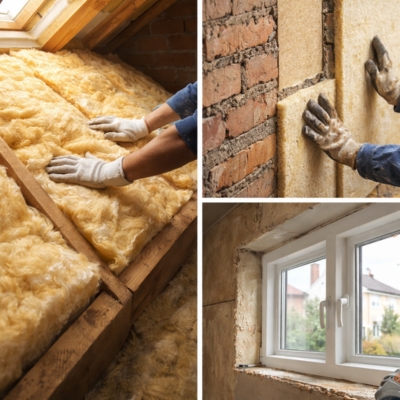
Insulation is assessed according to the building’s actual configuration. Accessible or converted lofts, party walls, gable walls, floors above cellars and windows do not all play the same role. In an older building, the nature of the walls and their behaviour in relation to moisture must be taken into account to avoid an overly airtight internal lining or a treatment that is unsuitable for the existing materials.
Ventilation and indoor air quality
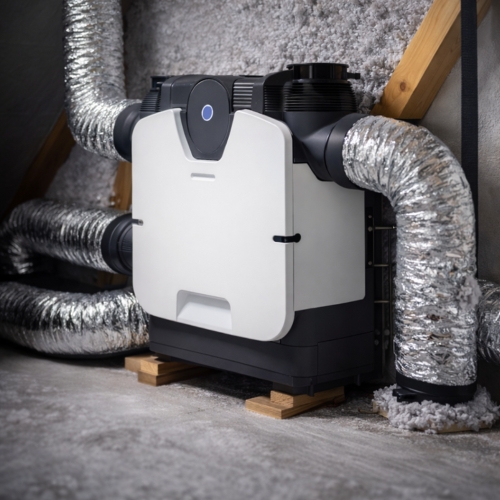
A better insulated and more airtight envelope changes the way air moves through the home. Ventilation must therefore be checked at the same time as insulation work. Air inlets, extraction points, gaps beneath doors and duct routes are assessed to maintain suitable air renewal and limit problems associated with poorly evacuated moisture.
Adaptation of the heating system
The heating system is assessed after the building envelope, as requirements may change once heat loss has been reduced. Depending on the home, it may be appropriate to keep, adapt or replace the existing installation. In a co-owned building, a communal system requires a different analysis from individual heating: some decisions cannot be taken at the level of a single apartment.

Hot-water production and controls
The renovation may also include domestic hot-water production and controls. Their selection depends on the number of occupants, available space, existing equipment and the technical organisation of the home. The aim is to make these elements work with the rest of the project, without adding equipment whose characteristics are disconnected from actual needs.

Typical situations in Moselle
Terraced workers’ house
In this type of home, the project may begin with an assessment of the roof, any exposed gable wall, the windows and the ground floor. Party walls are not treated in the same way as external façades. The heating system is then reviewed while taking into account the improvements made to the building envelope.
Older stone or brick house
Thick walls, large loft spaces and vaulted cellars require particular attention to moisture transfer. If external wall insulation is not feasible for architectural or planning reasons, an internal solution must incorporate careful treatment of junctions, wall returns and thermal bridges.
Apartment in a post-war building
In Metz in particular, some works may depend on the co-ownership: façade, roof, communal heating or shared distribution network. The programme then distinguishes between works that can be carried out within the apartment and those that must be decided at building level, so that technical responsibilities remain clear.
Grants and funding
Depending on the nature of the project, the home, the selected works and the eligibility conditions, a global renovation may qualify for schemes such as MaPrimeRénov’, CEE (energy savings certificates), reduced VAT or éco-PTZ (zero-interest eco-loan). Some grants notably require the use of an RGE-certified professional for the relevant work. Eligibility must be checked against the programme actually planned and before making commitments that could affect the application.
To structure your project in Moselle, you can contact GRAM Énergie to discuss the areas to assess and how they should be coordinated. To check the rules governing public schemes, eligibility conditions and procedures applicable to your situation, also consult the official France Rénov’ website.
How we work

Initial assessment
We examine the layout of the home, its envelope, its equipment and visible constraints that may influence the programme of works.

Prioritisation
The different areas are organised according to their technical coherence, with particular attention to interactions between insulation, ventilation and heating.

Choice of solutions
The techniques considered are adapted to the existing materials, available space, uses and constraints specific to the building.
Organisation of the programme
The order of work is defined to avoid sizing equipment before the home’s needs have been reassessed.

Overall review
A complete review of the project makes it possible to check the compatibility of the different elements and identify any points that still require a decision.
Our other services in Moselle
A project may also require a heat pump in Moselle, insulation work, the installation of a thermodynamic water heater or an energy audit. You can also view our page dedicated to energy renovation in the département, our approach across Grand Est and information dedicated to energy renovation in Metz.
Frequently asked questions
Should the heating system be replaced first?
Not necessarily. When insulation needs to be improved, it is generally preferable to assess heat loss and the behaviour of the building envelope first. Equipment selected before this work may no longer match the home’s future requirements. The order therefore depends on the initial condition and the selected programme.
Can an older house undergo a global renovation?
Yes, but the solutions must respect the way the building works. Older stone or brick walls are not treated in the same way as modern walls. The choice of insulation, finishes and ventilation must notably take account of moisture, existing materials and thermal bridges.
How should an apartment with communal heating be handled?
Private elements must be distinguished from communal equipment. Windows or certain internal works may fall under the apartment, while the boiler room, communal distribution system, roof or façade may require a co-ownership decision. The individual project must therefore be developed with this organisation in mind.
Is an audit useful before carrying out several types of work?
An energy audit can help compare different scenarios and understand the interactions between different areas before undertaking a major renovation. It provides a structured assessment of the existing situation and the improvements that may be considered. Its usefulness nevertheless depends on the home, any grant route and the scale of the planned work.
Let’s talk about your project
Tell us about your home and your goals: we help you prioritise the works and identify the grants worth looking into.