

Heat pump in Haut-Rhin (68)
Installing a heat pump involves looking well beyond the appliance itself. In Haut-Rhin (68), the result depends in particular on the level of insulation, the volume to be heated, the existing emitters and the constraints specific to the building. A terraced workers’ house in Mulhouse, an old timber-framed property in Colmar or a village farmhouse do not impose the same choices. Before selecting equipment, it is therefore necessary to assess the actual heating requirements, the required operating temperatures and the space available for the units, then check that the whole system remains consistent with the building envelope and ventilation.

Tip: have your energy performance certificate (DPE) and energy bills to hand for a more accurate estimate.
Why install a heat pump in Haut-Rhin
The heating season can be long in Haut-Rhin, which makes sizing particularly important. In Mulhouse’s workers’ houses, party walls limit some lateral heat loss, while roofs, gable walls and windows can have a greater impact on requirements. Installing a heat pump without taking these areas into account can lead to selecting an unsuitable output. Prior improvement of the building envelope can, by contrast, significantly alter the heating demand that needs to be covered.
In village houses and former farmhouses, large internal volumes and massive walls can also require careful assessment. Their thermal inertia slows temperature variations, but it does not replace insulation. In old timber-framed buildings, the heating system must also form part of a renovation that respects the moisture behaviour of the walls. The heat pump is therefore assessed after reviewing heat loss, ventilation and the existing heat distribution system.
What heat pump installation includes
Assessment of heating requirements
The first step is to determine whether a heat pump is suitable for the property and its requirements. The assessment takes account of floor areas, volumes, insulation level, walls facing outside and heating habits. The calculation must reflect the actual or future condition of the building, particularly when work on the envelope is planned as part of the same project.

Choosing the type of heat pump
The choice between different configurations depends on the existing system, the emitters and the space available. An installation supplying a water circuit does not have the same constraints as a system distributing air directly. It is also necessary to consider any domestic hot-water production, control requirements and compatibility with equipment retained in the property.

Checking radiators or underfloor heating
Emitters play a decisive role in the operation of a heat pump. Older radiators may require different water temperatures from underfloor heating. Their surface area, output and distribution must therefore be assessed. Depending on the situation, some emitters can be retained, adapted or replaced in order to maintain consistent heat distribution throughout the different rooms.
Positioning the outdoor unit
The location of the outdoor unit must be chosen according to airflow, accessibility, the distance from indoor components and the immediate surroundings. In a densely built area or a terraced house, positioning must also take account of façades, property boundaries and the proximity of windows. The location is an integral part of the technical assessment.
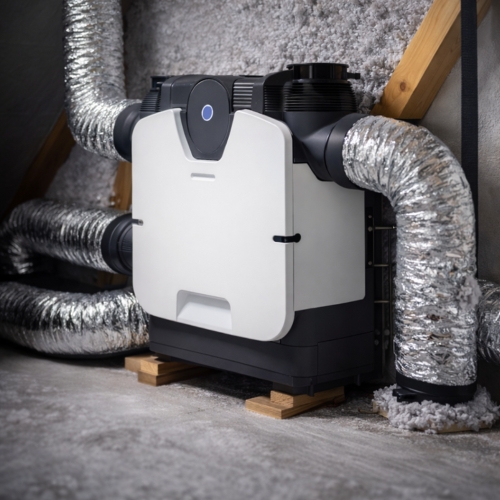
Controls and overall system consistency
An installation is not limited to connecting a new appliance. The controls must allow the heating system to adapt its operation to the needs of the property. Settings take account of the emitters, desired temperatures and the organisation of heated zones. Where other work is planned, the controls must remain compatible with future changes in the building’s heating requirements.

Typical situations in Haut-Rhin
Terraced workers’ house in Mulhouse
The property may have relatively limited heat losses through party walls, but greater losses through a gable wall, roof or windows. Before sizing a heat pump, it is therefore important to distinguish between the walls actually exposed and to check whether additional insulation is planned.
Old timber-framed house in Colmar
Where external insulation is not suitable for the façade, improvements may focus on the loft, certain internal walls or floors. The heating system must then be sized according to these choices, while maintaining ventilation that is compatible with old walls that are sensitive to moisture transfer.
Farmhouse or large village house
High rooms, successive extensions or the distribution of radiators can complicate the assessment. A heat pump must be selected after examining the volumes actually heated, any hydraulic network and the output required during cold periods, without relying solely on the habitable floor area.
Grants and funding
Depending on the equipment, the property and the applicant’s circumstances, the installation of a heat pump may be covered by MaPrimeRénov’, CEE (energy savings certificates), reduced VAT or éco-PTZ (zero-interest eco-loan). Conditions vary according to the type of system and the characteristics of the project. Some grants require the use of an RGE-certified professional. It is therefore necessary to check the applicable criteria before commissioning the work.
You can contact GRAM Énergie to assess the technical consistency of the project and any work associated with the installation. To find out the official rules relating to MaPrimeRénov’, other public schemes and qualification requirements, also consult France Rénov’ before making any commitment.
How we work

Building assessment
We examine the volumes, insulation, existing equipment and the main thermal constraints of the property.

Emitter assessment
We check the heating network, radiators or underfloor heating to assess their compatibility with the project.

System sizing
The output and configuration are defined according to the building’s requirements and any planned work on the envelope.

Choosing the location
We assess the position of the units and the required connections, taking account of accessibility and the immediate surroundings.

System adjustment
Operation and controls are adjusted to remain consistent with the emitters and the characteristics of the property.
Our other services in Haut-Rhin
A heating project can be combined with a global energy renovation in Haut-Rhin, insulation work, a thermodynamic water heater or an energy audit. You can also view our page dedicated to energy renovation in Haut-Rhin, our information on Grand Est and our local pages for Mulhouse and Colmar.
Frequently asked questions
Is a heat pump suitable for an old house?
Yes, depending on the building’s configuration. Age alone is not enough to decide. Heat loss, insulation, emitters and the required water temperature all need to be assessed. In a poorly insulated old house, work on the building envelope may be appropriate before the final output and type of equipment are determined.
Do all existing radiators need to be replaced?
Not necessarily. Some radiators may be compatible with a heat pump if their sizing allows the property to be heated properly at the selected operating temperature. The assessment must check their output, condition and distribution. Replacement can be considered only for emitters that are not suited to the new operating conditions.
Where should the outdoor unit be placed in a terraced house?
The location must allow good airflow and sufficient access for maintenance, while taking account of windows and neighbouring properties. In dense streets or workers’ housing estates, the available space may be limited. Several locations may sometimes need to be compared before selecting a technically suitable solution.
Should a property be insulated before installing a heat pump in Haut-Rhin?
It depends on the condition of the property. Where the roof, walls or windows have significant heat losses, treating them before final sizing can change the heating requirements. This approach avoids selecting the appliance solely on the basis of a thermal situation that will be different after insulation work.
Let’s talk about your project
Tell us about your home and your goals: we help you prioritise the works and identify the grants worth looking into.